
How to Dress Over 50 When You Don’t Like Your Arms
If you hesitate every time you reach for a sleeveless top, you’re not alone.
And no, this isn’t about confidence speeches or being told to “just wear it anyway.”
This is about getting dressed without feeling exposed, frumpy, or boxed into the same long-sleeve uniform all year long.
The good news is this: you do not need to hide your arms to look polished.
You just need to stop using the same outdated fixes that make outfits heavier than they need to be.
Let’s talk about what actually works.
Before Anything Else
Disliking your arms does not mean:
You have to cover them completely
You’re doing something wrong
You’re stuck in cardigans forever
Most arm frustration comes from how sleeves hit, not how your arms look.
Length, shape, fabric, and where the eye lands matter far more than coverage.
Once you understand that, everything gets easier.
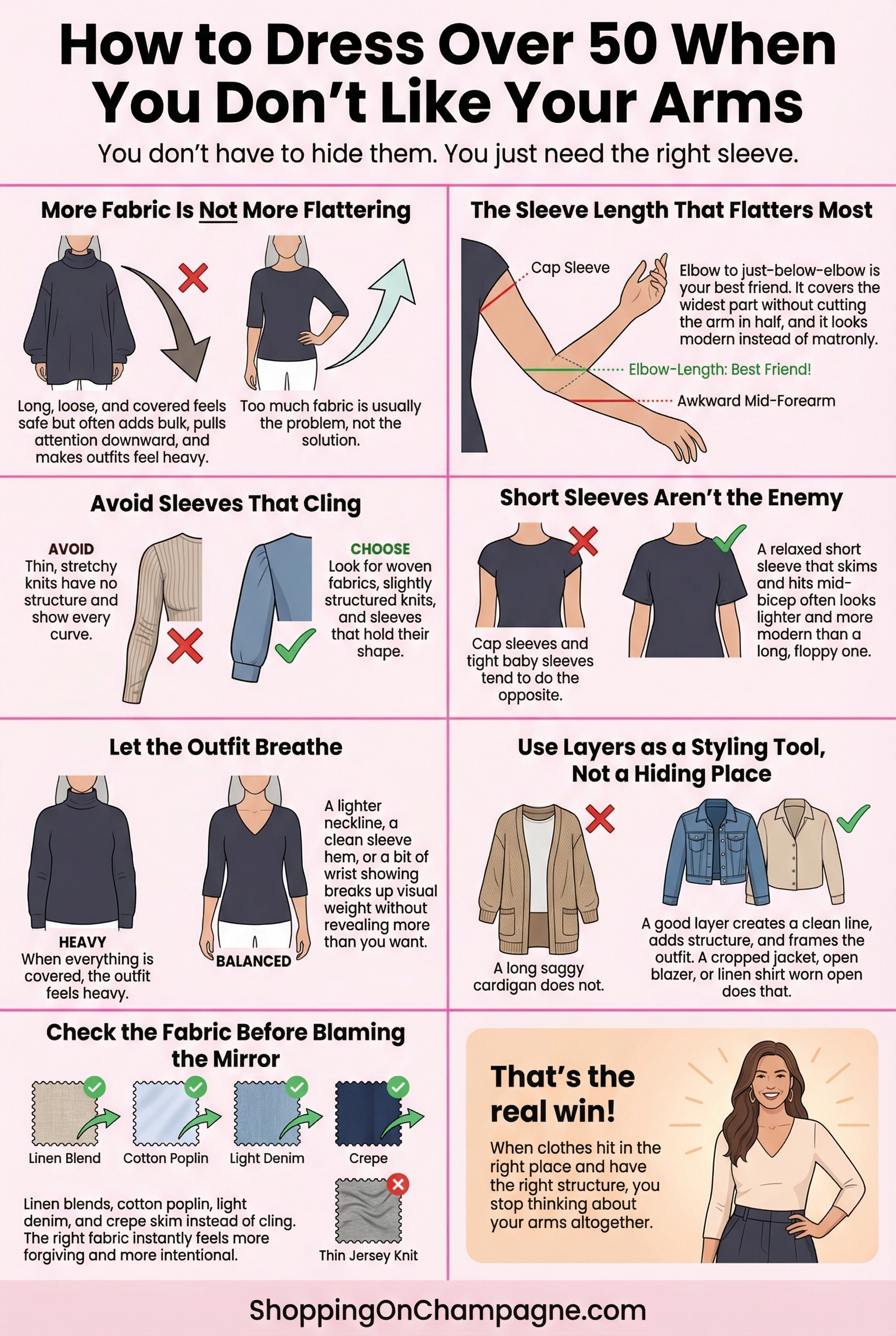
The Biggest Mistake: Going Long and Loose Every Time
This is the default for a lot of women:
Long sleeves
Loose fabric
Extra length
Soft drape
It feels safe. But visually, it often:
Adds bulk
Pulls attention downward
Makes outfits feel heavy and dated
More fabric does not automatically equal more flattering.
In fact, too much fabric is often the problem.
So let’s talk about what to do about it.
The Sleeve Length That Flatters Most (And Why)
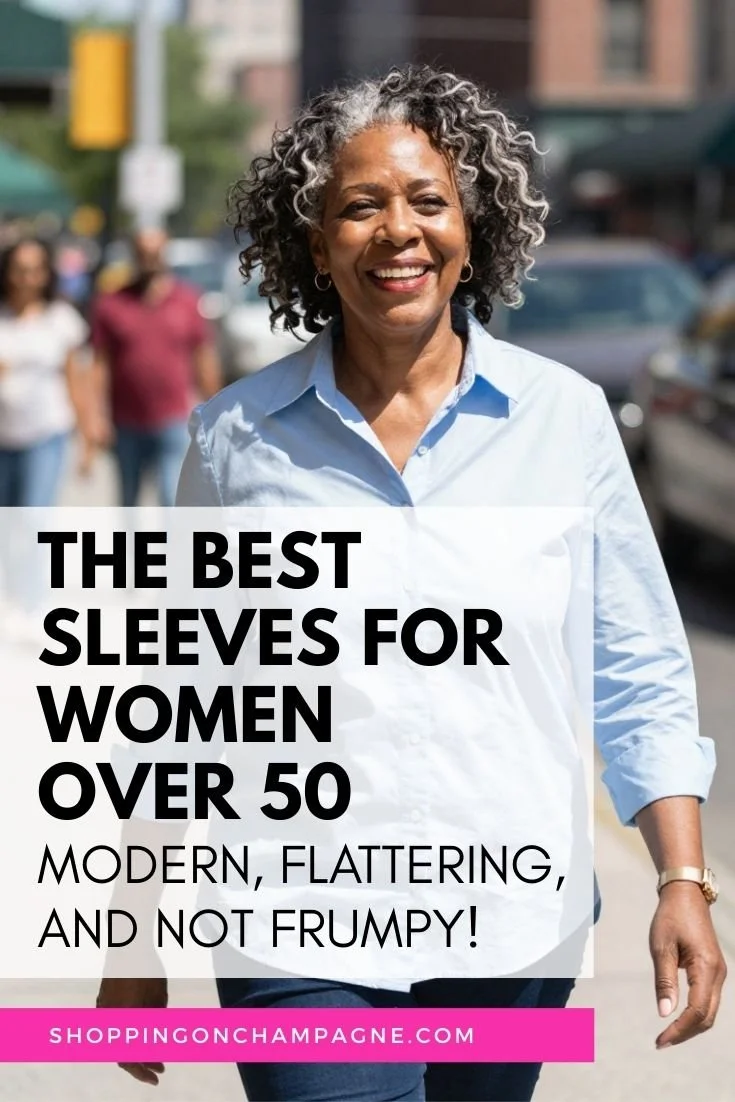
If you don’t love your arms, your best friend is the elbow-to-just-below-elbow sleeve.
Why it works:
It covers the widest part without cutting the arm in half
It keeps the outfit light and intentional
It looks modern, not matronly
Think:
Elbow-length
Bracelet-length
Relaxed three-quarter sleeves
Avoid sleeves that end right at the thickest part of the arm. That’s what creates that “why does this look off?” feeling.
Now, I want to note that these sleeve lengths go in and out of style. If they are currently in style, you’ll have tons of options to choose from.
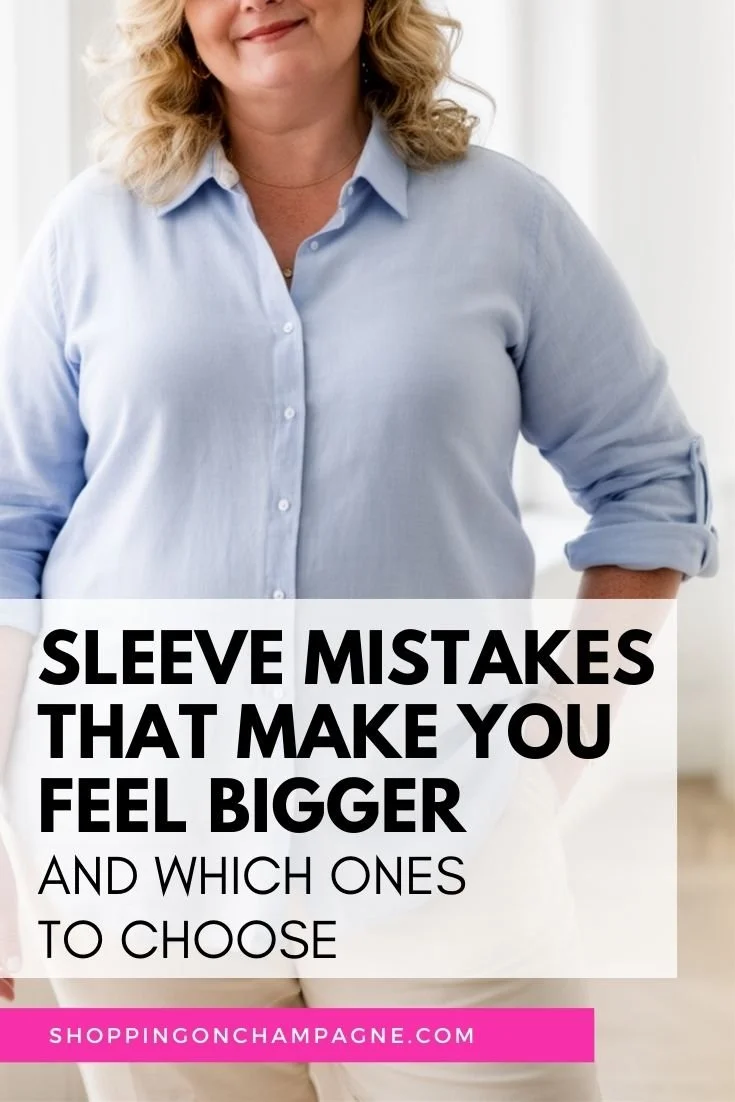
However, if you buy long-sleeved shirts and roll the sleeves, you’ll be able to have the exact length you want without having to worry about trends.
Stop Choosing Sleeves That Cling
Thin, clingy knits are brutal on arms.
Not because of your arms, but because the fabric has no structure.
Look instead for:
Woven fabrics
Slightly structured knits
Sleeves with shape, not stretch
A sleeve that holds its form creates a clean line, and clean lines always look more polished.
Why Short Sleeves Aren’t the Enemy
I know. This one surprises people.
A well-cut short sleeve can look better than a long, floppy one.
Look for:
Sleeves that skim, not grip
Slightly wider openings
A bit of structure
Cap sleeves and tight baby sleeves tend to exaggerate the upper arm. A relaxed short sleeve that hits mid-bicep often looks lighter and more modern.
The Power of “Air” (Without Being Revealing)
One of the easiest ways to make arms look better is to show skin somewhere else.
Not a lot. Just enough.
For example:
A lighter neckline
A cropped sleeve with a clean hem
A bit of wrist showing
When everything is covered, the outfit feels heavy. When there’s a little air, the eye moves and the outfit breathes.
This isn’t about showing more skin.
It’s about breaking up the visual weight.
Third Pieces That Actually Help (Not Hurt)
Yes, layers can help.
But only if they’re doing the right job.
A good layer is not a hiding place. It’s a styling tool. And it should do at least one of these three jobs:
Create a clean line.
A layer should skim your body and create a smooth outer shape, not cling and not balloon. If it hangs limp or stretches out, it adds bulk instead of polish.
Add structure where the outfit needs it.
This is why a denim jacket, a blazer, or a crisp shirt worn open can be magic. A little structure keeps the outfit looking intentional, even if what’s underneath is simple.
Frame the outfit, not swallow it.
The best layers act like parentheses around your look. They help the eye move up and down instead of landing on one spot and staying there. That’s why an open front is usually more flattering than something closed and bulky.
The layers that usually work best when you don’t love your arms:
A cropped jacket (hits around the waist or high hip)
A shirt worn open like a light topper (linen, chambray, poplin)
A modern blazer worn open with pushed-up sleeves
A lightweight cardigan that has shape and doesn’t droop
The layers that usually make it worse:
Long, saggy cardigans that pull the outfit down
Chunky knits that add width everywhere
Anything oversized and long at the same time (that combo can feel like a blanket)
If your layer makes you feel “covered” but also heavier and more frumpy, it’s not doing the job.
The right layer makes you feel pulled together.
Fabric Matters More Than You Think
If your arms feel like the problem, check the fabric before blaming the mirror.
Better choices:
Linen blends
Cotton poplin
Light denim
Crepe or soft twill
These fabrics skim instead of clinging, which instantly feels more forgiving and more intentional.
You Don’t Need to Love Your Arms to Dress Well
Here’s what I want you to remember: you don’t have to suddenly love your arms to dress well.
You don’t have to force yourself into sleeveless tops. And you definitely don’t have to “get over it.”
You just need clothes that:
Hit in the right place
Have the right structure
Work with your body, not against it
When clothes do their job, you stop thinking about your arms altogether.
And that’s the real win.
Want help with this?
If you are ready to stop guessing and start making real progress, I have tools that will walk you through every step of this journey. Whether you are just getting started, ready to build a wardrobe that truly works for your life, or want a fully personalized experience, I have something for you at every level.
You can find all of them linked below.👇

You have a closet full of clothes and still nothing to wear.
You're holding onto pieces that don't fit, don't flatter, and honestly don't even feel like you anymore. Some still have the tags on. Some belong to a job, a body, or a chapter you've already closed.
👉🏻 You're not alone, and you don't need a total overhaul to feel better about getting dressed.
The Closet Detox is your step-by-step reset. Work through every item with 18 honest questions, a decision guide for the hard ones, and a clear action plan for what comes next.
💌 What's Inside:
✅ 18 questions to ask about every single item in your closet with honest, practical guidance on what to do with each answer
✅ A decision guide for the six hardest pieces to let go of
✅ A What Comes Next action plan - three things to do before you bring in a single new thing, so you never end up back where you started
✅ Live links to the Style Refresh Blueprint and the Champagne Edit - two ways to keep the momentum going
👗 This is for you if...
You have a full closet, but nothing to wear
You've been holding onto things out of guilt, sentiment, or "just in case."
You're done dressing for a body, a job, or a life you no longer have
You're ready to open your closet and actually feel good about what's in there
💡 Why It Works:
Every question is designed to cut through the noise and help you make a clear, confident decision about every single item without second-guessing yourself the whole way through.
Your closet should feel like you. This is where that starts.
This is a digital download. You will receive a PDF immediately after purchase.