
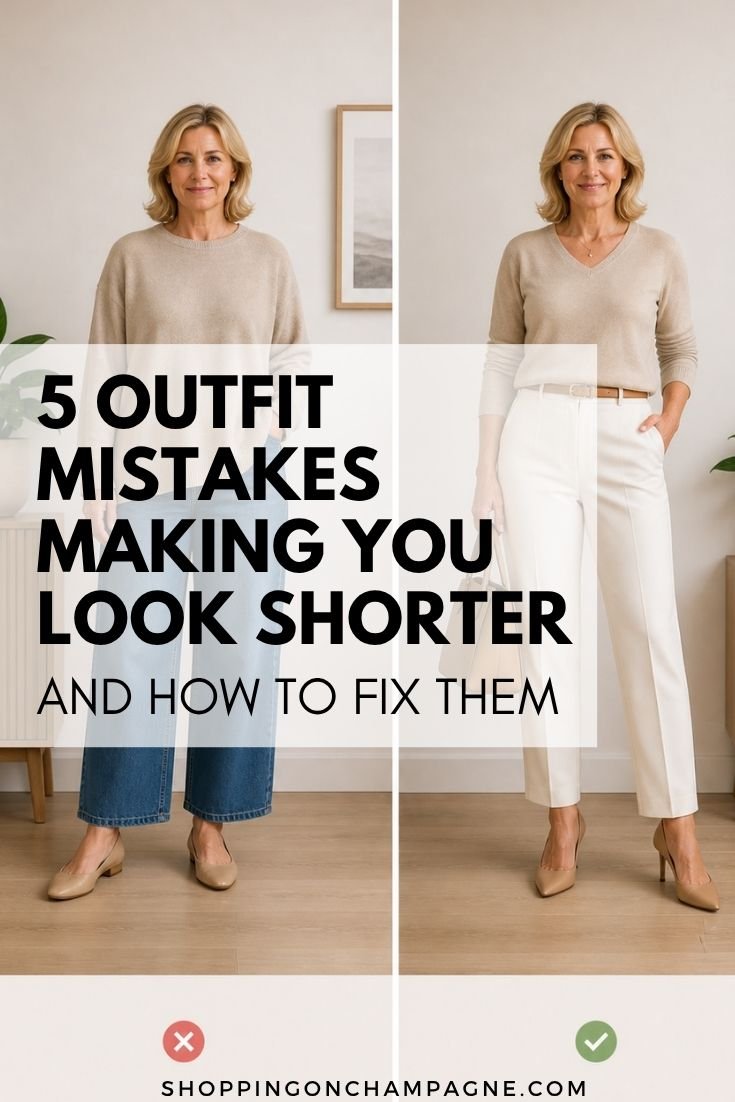
5 Style Mistakes That Make You Look Shorter (and How to Fix Them)
You pulled on an outfit this morning that felt fine in your head.
But when you looked in the mirror, something was off.
You looked shorter than you are. A little wider. A little more wrapped up than you wanted to be.
You could not put your finger on what went wrong.
I have been there. And once I started understanding proportion, I realized most of what I had been doing for years was working against me.
Not because the clothes were wrong, exactly. But because of the way I was putting them together.
These five mistakes are the ones I see most often, and they are also the easiest to fix once you know what to look for.
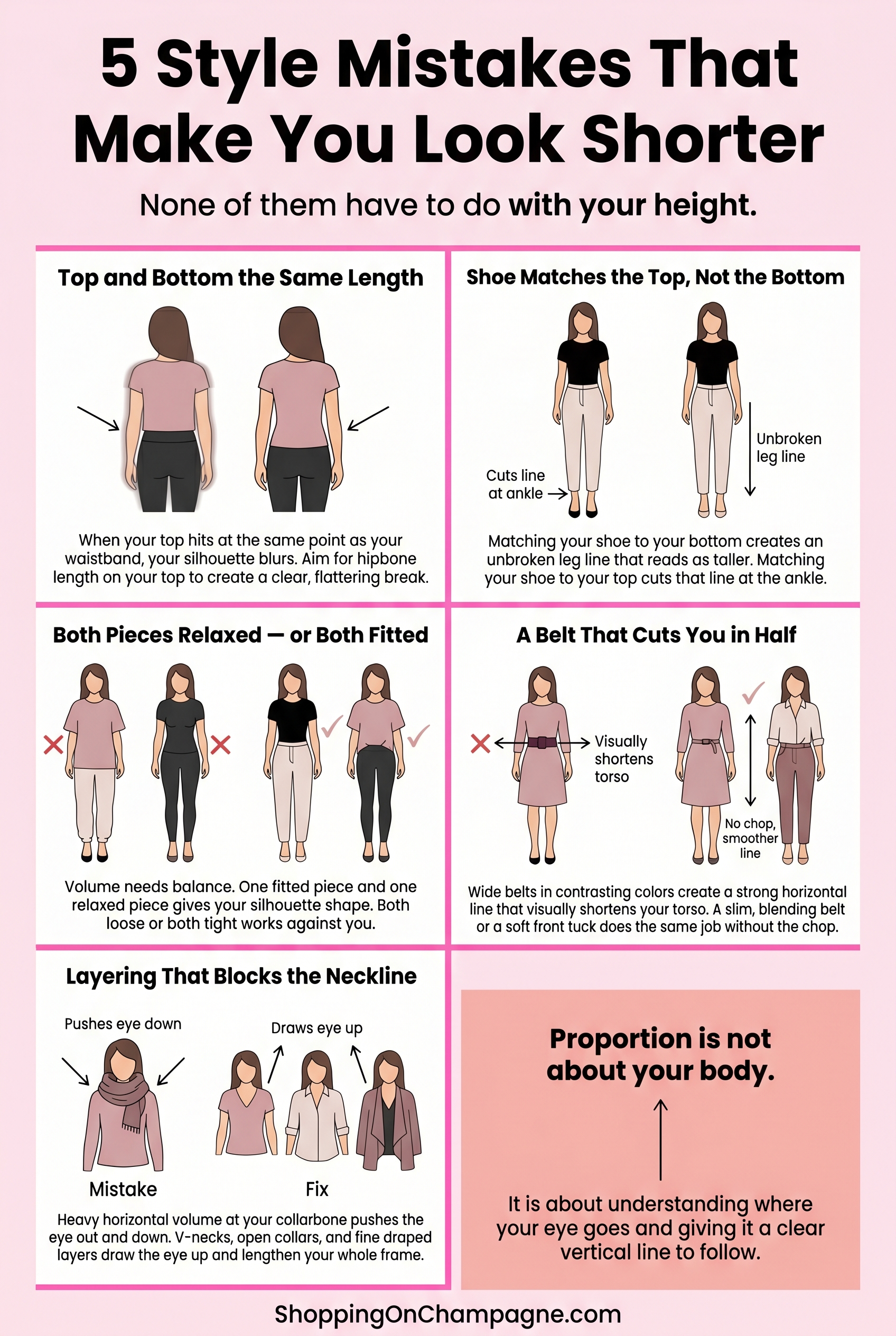
Mistake 1: Wearing Your Top and Bottom the Same Length
This one is subtle, but it is doing a lot of damage.
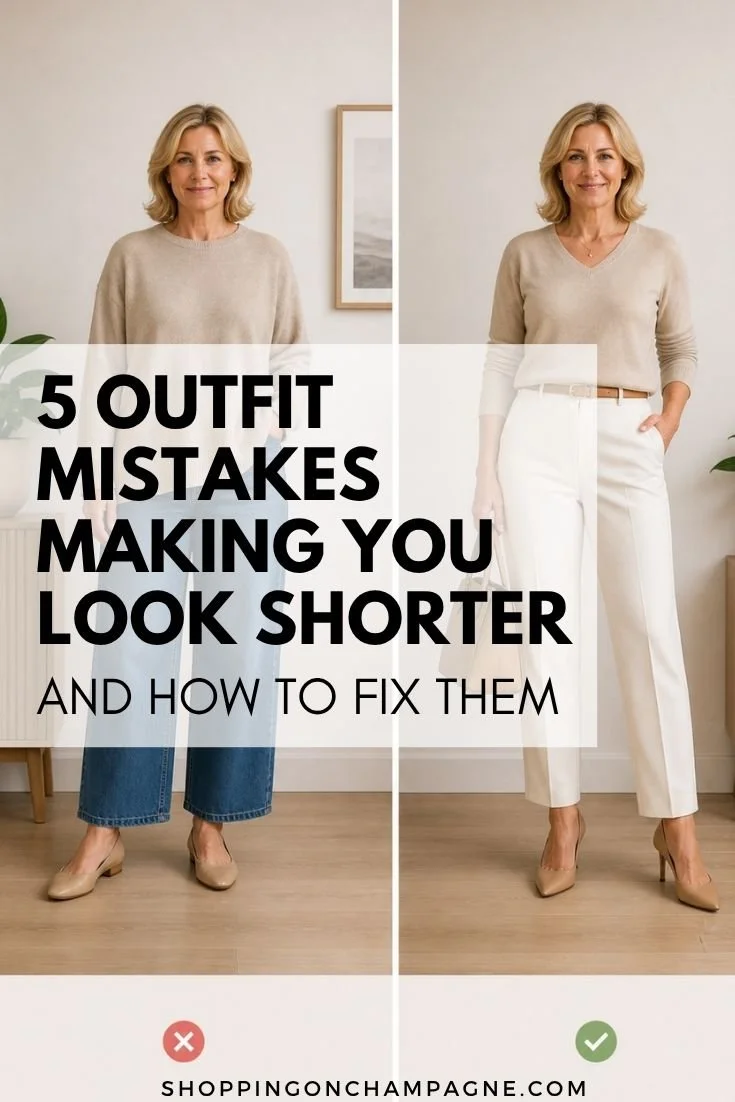
When your top hits at mid-hip and your pants sit at mid-hip, you lose any visual line that gives your body length.
Everything blurs together, and the result is that you look shorter and wider than you actually are.
The key is to deliberately break the silhouette.
Either go shorter on the top (hipbone length is universally flattering and one of my absolute non-negotiables) or go longer.
What you want to avoid is that ambiguous middle zone where your eye cannot find a clear stopping point.
Hipbone length is where I always land. It does not feel too short.
It does not feel like a tunic.
It gives you a waistline without anything being fitted.
If you are not sure where your hipbone is, put your hands on your hips and feel where the bone is. That is your line.
Tops that hit there will work on almost everybody.
Mistake 2: Matching Your Shoe to Your Top Instead of Your Bottom
This one surprised me the first time I really thought through it, but once you see it, you cannot unsee it.
When your shoe matches your bottom, it creates an unbroken line of color from your hip to the floor. Your leg reads as longer. Your whole silhouette reads as taller.
When your shoe matches your top instead, you are visually cutting yourself in half at the ankle. Your eye stops there. The line breaks.
And you lose all that length you could have had.
This is why a nude shoe or a white sneaker works so well with white jeans or cream trousers.
The line just keeps going. It is the same reason I pair my navy sneakers with navy pieces and my white ones with lighter bottoms. I am not doing it because it is a rule I memorized.
I am doing it because it genuinely makes me look taller.
Mistake 3: Wearing Both Pieces Relaxed or Both Pieces Fitted
I think of this as the volume problem.
When everything is loose and boxy at once, your body disappears into the outfit.
When everything is tight and fitted at the same time, there is nowhere for the eye to rest, and you can end up looking wider.
The silhouette that works is one fitted piece and one relaxed piece. That is it.
One fitted, one relaxed. Never both fitted, never both relaxed.
In practice, this looks like a fitted turtleneck with wide-leg trousers.
Or an oversized button-front shirt with slim jeans.
Or a boxy blazer over a fitted dress.
You are always balancing the volume.
One side of the outfit does the work, so the other one does not have to.
This was genuinely one of the things that helped me most after I gained some weight a few years ago and was hiding in oversized everything.
I thought bigger clothes would make me look smaller. They did not.
They just made me disappear.
Adding one fitted piece back into the equation changed everything.
Mistake 4: Wearing a Belt That Cuts You in Half
A belt can be a beautiful thing. It can also be the thing that chops you right at the narrowest part of your torso and makes you look four inches shorter.
Wide statement belts are the biggest offenders.
When you wear a thick belt in a contrasting color, your eye goes directly to that horizontal line, and your body reads in two separate halves.
The wider the belt and the greater the contrast between the belt and the outfit, the more dramatic the effect.
If you want to define your waist (and you absolutely can), go with a slim belt in a color that blends with what you are wearing, not one that stands out.
Or do a soft front tuck into your waistband.
A clean front tuck gives you the same visual line without a belt, and it does not break your silhouette the way a wide belt can.
Mistake 5: Breaking Your Neckline With the Wrong Layering
This is the one I see least often talked about, and it is worth paying attention to.
When you add a layer, whether that is a cardigan, a blazer, a sweater over your shoulders, a scarf, anything, that layer creates a new visual line at your neckline.
If that line is horizontal and sits too low on your chest, it interrupts the vertical length you want.
V-necks, open collars, and sweaters tied loosely at the front all draw the eye up and in. They lengthen your neck and your torso.
Closed collars, chunky cowls, or anything that adds significant horizontal volume right at your collarbone does the opposite.
This does not mean you cannot layer.
Layering is one of the most useful things you can do in your wardrobe, and I live in layers.
The key is to pay attention to where the layer begins and how it affects your neckline.
A sweater over my shoulders works beautifully for this because it adds the third piece without adding anything to the front of my body.
A draped scarf in a fine fabric does the same.
You are adding polish without blocking the vertical line.
The Fix That Ties All of This Together
All five of these mistakes are really about the same thing: your eye following a clear, unbroken vertical line, or not.
When that line is there, you read as taller.
When something cuts, widens, or blurs it, you lose height.
The good news is that none of these is about buying new clothes. They are about noticing what the outfit is doing and making small adjustments before you walk out the door.
A quick mental checklist:
Does my top break at the hipbone or close to it?
Does my shoe match my bottom?
Is one piece fitted and one relaxed?
Is my belt adding or subtracting?
Does my layering work with my neckline or against it?
That is all you need.
Want help with this?
If you are ready to stop guessing and start making real progress, I have tools that will walk you through every step of this journey. Whether you are just getting started, ready to build a wardrobe that truly works for your life, or want a fully personalized experience, I have something for you at every level.
You can find all of them linked below.👇


You have a closet full of clothes and still nothing to wear.
You're holding onto pieces that don't fit, don't flatter, and honestly don't even feel like you anymore. Some still have the tags on. Some belong to a job, a body, or a chapter you've already closed.
👉🏻 You're not alone, and you don't need a total overhaul to feel better about getting dressed.
The Closet Detox is your step-by-step reset. Work through every item with 18 honest questions, a decision guide for the hard ones, and a clear action plan for what comes next.
💌 What's Inside:
✅ 18 questions to ask about every single item in your closet with honest, practical guidance on what to do with each answer
✅ A decision guide for the six hardest pieces to let go of
✅ A What Comes Next action plan - three things to do before you bring in a single new thing, so you never end up back where you started
✅ Live links to the Style Refresh Blueprint and the Champagne Edit - two ways to keep the momentum going
👗 This is for you if...
You have a full closet, but nothing to wear
You've been holding onto things out of guilt, sentiment, or "just in case."
You're done dressing for a body, a job, or a life you no longer have
You're ready to open your closet and actually feel good about what's in there
💡 Why It Works:
Every question is designed to cut through the noise and help you make a clear, confident decision about every single item without second-guessing yourself the whole way through.
Your closet should feel like you. This is where that starts.
This is a digital download. You will receive a PDF immediately after purchase.